
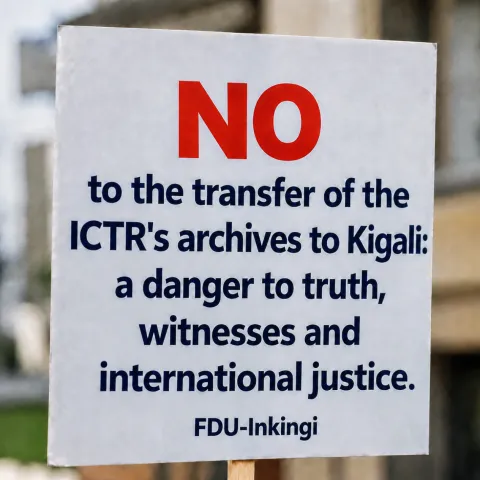
No ICTR archives for Kigali: a danger to truth, witnesses and international justice
The FDU-INKINGI express their deep concern and their total opposition to the proposed physical transfer of the archives of the International Criminal Tribunal for Rwanda (ICTR) to the Republic of Rwanda.
This project poses serious legal and political risks. It threatens the preservation of judicial truth, the protection of witnesses, the security of confidential documents and the very credibility of international justice.
A breach of the United Nations legal framework
Rwanda claims ownership of the ICTR archives in the name of a so-called “national historical heritage”. This claim, however, conflicts with the legal framework established by the United Nations.
The ICTR archives remain the inviolable property of the United Nations, in accordance with Security Council resolution 1966 (2010) and Article 27 of the Statute of the International Residual Mechanism for Criminal Tribunals. Resolution 1966 (2010) expressly entrusts the International Residual Mechanism for Criminal Tribunals (IRMCT) with responsibility for the management, preservation and access to these archives.
The Mechanism was established precisely to complete the work of the ICTR and the International Criminal Tribunal for the former Yugoslavia (ICTY) after the expiry of their mandates. It is therefore inconceivable that the ownership of documents belonging to an international criminal jurisdiction established under Chapter VII of the United Nations Charter could be transferred to a State directly concerned by the facts adjudicated.
The FDU-INKINGI forcefully reaffirm: the ICTR archives are not the property of Rwanda. They belong to the United Nations and must remain under United Nations ownership.
A threat to truth and witnesses
The ICTR archives are not a mere documentary repository. They contain exhibits, unpublished investigative material, testimonies, evidence and information gathered in the course of international judicial proceedings.
They concern, in particular, crimes and serious violations of international humanitarian law committed in Rwanda and by Rwandan nationals in neighbouring States between 1 January and 31 December 1994. They also contain material relating to crimes attributed to members of the RPF-Inkotanyi, including the 6 April 1994 attack on the aircraft carrying President Juvénal Habyarimana.
The physical transfer of these archives to Kigali would amount to entrusting sensitive investigative documents to a party directly concerned by the events. Such a decision would undermine the neutrality of international justice and seriously weaken the protection of witnesses, particularly those who testified in camera or against the RPF-Inkotanyi.
The risk is clear: data leaks, intimidation, reprisals against witnesses and their families, and the destruction, manipulation or political exploitation of confidential information.
The FDU-INKINGI demand that the confidentiality safeguards provided for in resolution 1966 (2010) be fully respected. That resolution requires the Mechanism to ensure the continued protection of confidential information, including information concerning protected witnesses and information provided in confidence.
Rwanda cannot be judge and party
The FDU-INKINGI are convinced that, if the Rwandan Government, entirely dominated by the RPF, obtained exclusive control over these archives, access to certain sensitive documents would be restricted, filtered or instrumentalised.
This is not merely an archival debate. It is a question of who will control the judicial memory of a tragic conflict, who will be able to consult the evidence, who will protect the witnesses and who will be able to establish the truth about all the crimes committed in Rwanda.
An international court is not mandated solely to convict perpetrators. It also has a duty to establish, as far as possible, a judicial truth based on the evidence submitted to it. Entrusting these archives to Rwanda would mean entrusting particularly sensitive judicial responsibilities to a system perceived as judge and party in its own cause. Such a development would open the door to impunity.
A political strategy of the Kigali regime
The FDU-INKINGI consider that the Kigali regime’s determination to obtain exclusive control over these archives forms part of a broader political strategy: to control memory, shape the historical narrative and conceal responsibilities that are inconvenient for the RPF’s hold on power.
This approach recalls the repeated pressure exerted to secure the transfer to Rwanda of persons convicted by the ICTR. The FDU-INKINGI see in it an attempt to remove these detainees from any effective international protection and to make political prisoners disappear—prisoners who have resisted the RPF since its attack on Rwanda on 1 October 1990.
The RPF regime will inevitably seek to exploit the confidential data contained in these archives for purposes of repression, political accusation and diplomatic pressure against States, organisations or individuals it regards as adversaries.
The FDU-INKINGI warn the international community: handing these archives over to Rwanda means placing in the hands of the Kigali regime a potential instrument of surveillance, reprisals and historical falsification.
Solemn appeal to the international community
The FDU-INKINGI issue a solemn appeal to the United Nations Security Council, the United Nations Secretary-General, the International Residual Mechanism for Criminal Tribunals and all Member States of the United Nations.
- They demand that any decision concerning the future of the ICTR archives be taken in strict compliance with international law, judicial independence, witness protection and the imperative of preserving historical truth.
- The FDU-INKINGI call on the Security Council to take a public position and to guarantee, through binding measures, that the ICTR archives remain under the exclusive ownership, custody and control of the United Nations. No physical transfer to Rwanda should be authorised without rigorous, independent and verifiable international safeguards.
- The FDU-INKINGI also call on democratic States, regional institutions, human rights organisations, jurists, historians, survivors and victims to maintain constant vigilance over this matter. The silence of international powers in the face of this threat would amount to capitulation before those who seek to impose a single, official version of history.
The international community must understand that what is at stake is not merely a debate over the location of archives. What is directly threatened is the protection of witnesses, the security of evidence, victims’ right to truth and the credibility of international justice.
Ultimately, the FDU-INKINGI solemnly warn the United Nations that Rwanda could never ensure effective international control over the archives. Therefore, this transfer would constitute a serious political and moral mistake towards the victims, witnesses, and the memory of the crimes committed in Rwanda.
The truth should never be handed over to those who have an interest in hiding it.
Paris, 9 November 2026
Dr Emmanuel MWISENEZA
Vice President of the FDU-INKINGI and Spokesperson
Notes
1.Article 27 of the ICTR Statute and United Nations Security Council resolution 1966 (2010). The archives remain the inviolable property of the United Nations.
2.The ICTR was established by United Nations Security Council resolution 955 (1994) to prosecute persons allegedly responsible for genocide or other serious violations of international humanitarian law committed in Rwanda, as well as Rwandan citizens allegedly responsible for such acts committed in the territory of neighbouring States, between 1 January and 31 December 1994.
3.An international court is not mandated solely to convict perpetrators. It also has a duty to establish, as far as possible, a judicial truth based on the evidence submitted to it. See Gaspard Musabyimana, Rwanda: “The Silences of the ICTR, An Investigation into the Heart of International Justice”, Éditions Scribe, Brussels, 2026, pp. 7-9.